




































































































































































































































































































































































































































































































































































































































































































































































































































































































































































































































































































































































































































































































































































































































































































































































































































































































































































































































































































































































































Antique Temple Jewellery Sets for Marriage: A South Indian Bride’s Buying Guide

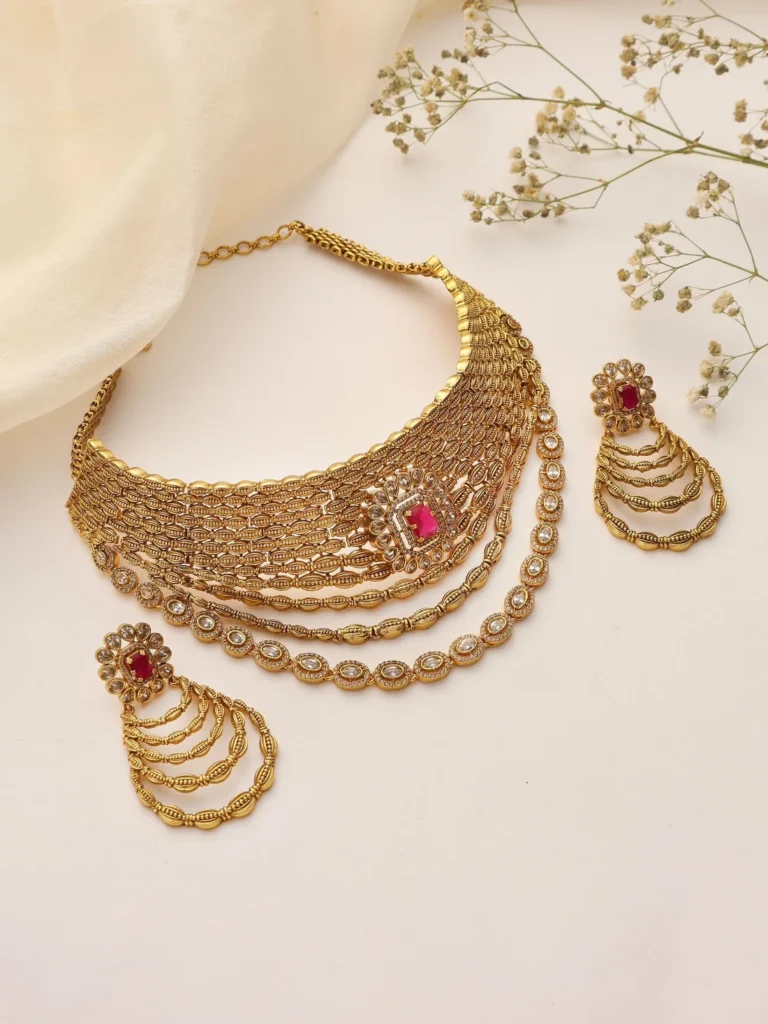
An antique temple jewellery set for marriage is really a small collection you assemble, not a single purchase. There is a neck piece that anchors the look, earrings that answer it, and a handful of supporting ornaments that fill in the rest. Most brides feel the pressure to buy all of it at once. You don’t have to. Get the anchor right, and everything else arranges itself around that one decision.
This guide covers what temple jewellery actually is, which pieces a South Indian bride traditionally wears, how temple and kundan work together across the wedding functions, and how to choose a set you will still be glad to see in the photographs years later.
What makes temple jewellery “temple” jewellery
Temple jewellery began as ornamentation for deities, not people. The craft traces to around the ninth century in South India, under the Chola rulers, when goldsmiths created pieces to adorn the idols of gods and goddesses inside temples. Over the generations it moved outward, first onto the classical dancers who performed in those temples, and then into the wedding trousseau of the South Indian bride. The town of Nagercoil in Tamil Nadu became so bound up with the craft that its temple jewellery now carries a Geographical Indication tag from the Government of India.
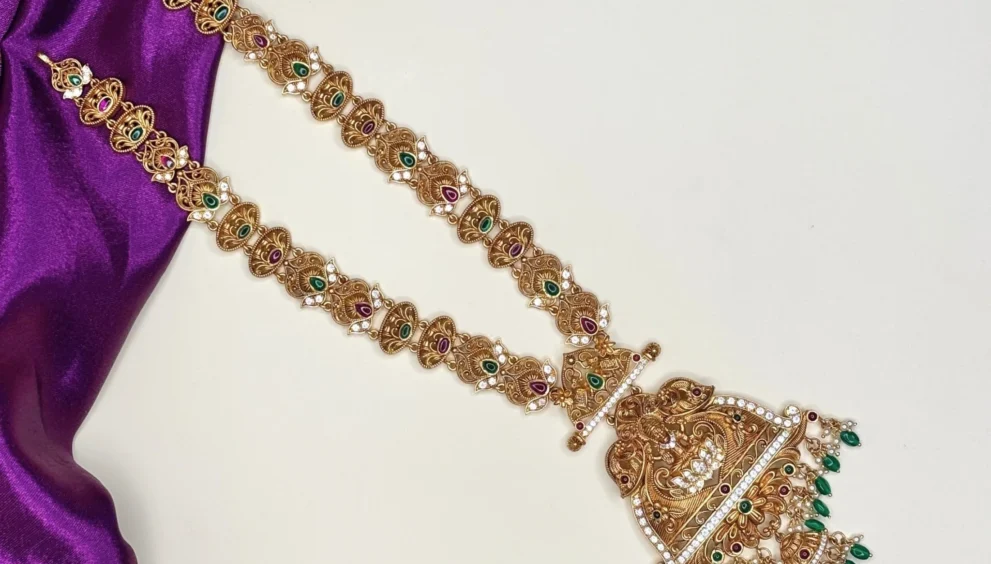
That origin still shows in the design. Goddess Lakshmi seated at the centre of a pendant, a peacock caught mid-strut, the lotus, the mango, rows of small embossed coins called kasu. These are devotional motifs before they are decorative ones. It is why the jewellery reads as grand rather than pretty, and why a single piece can carry a whole bridal look.
“Antique” here describes a finish, not the age of the piece. An antique or oxidised finish darkens the recesses of the metal so the raised motifs stand forward. The effect is that aged, temple-idol depth you picture when you think of heirloom jewellery. Bright gold polish does the reverse, flattening the contrast for more shine. Neither is better. An antique finish suits heavy silk and a traditional muhurtham; a brighter one photographs livelier under reception lighting. Look at both in daylight before you decide, because showroom light hides how much depth a piece actually has.
The pieces in a South Indian bridal temple set
A full traditional set has more elements than most brides end up wearing, and that is completely fine. Here is what carries the look, roughly in order of importance.
Neckwear: the long haram and the short necklace
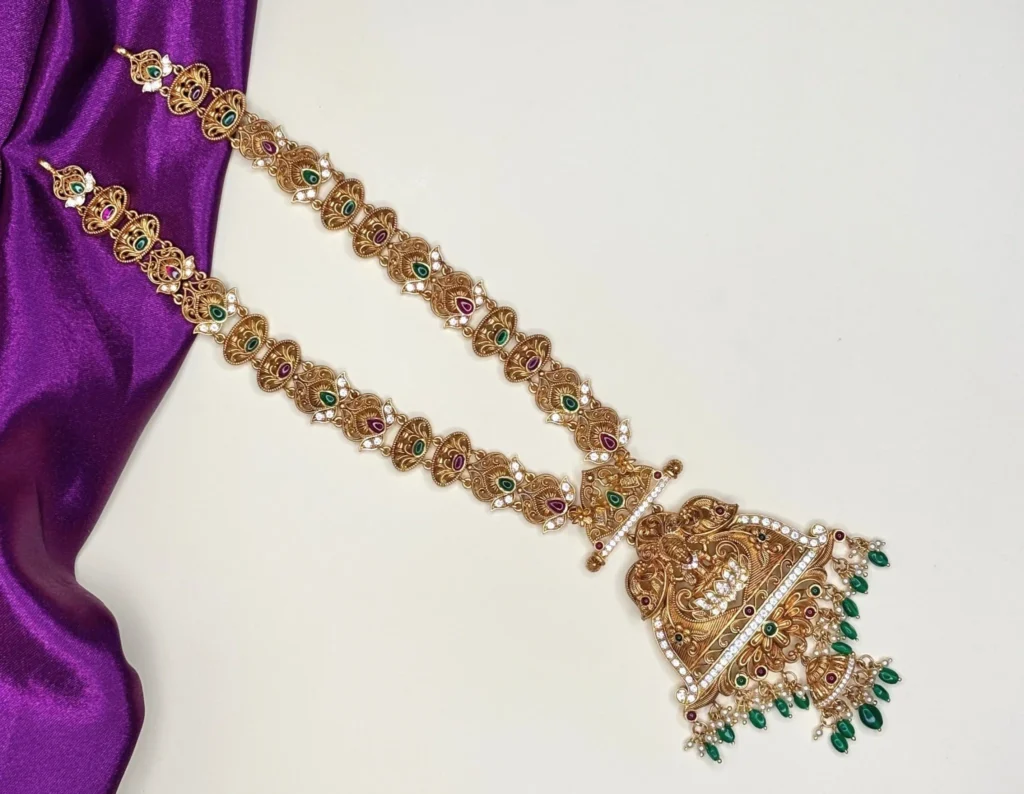
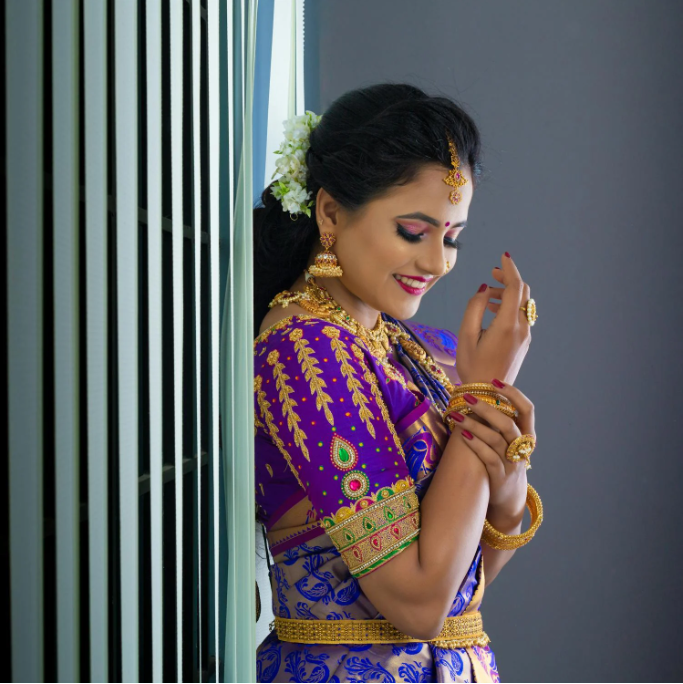
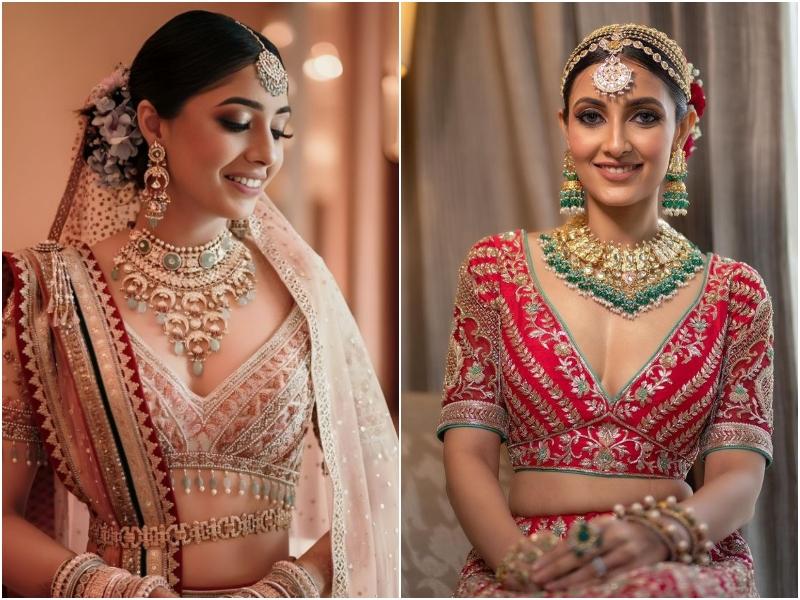
Neckwear is where the money and the impact go. Two pieces do most of the work. The short necklace sits high, close to the collarbone; a close-fitting version is sometimes called an attigai. The long haram falls to the chest or lower, often built from linked kasu coins, mango motifs, or repeating Lakshmi medallions. Brides classically wear both, layered together, one short and one long.
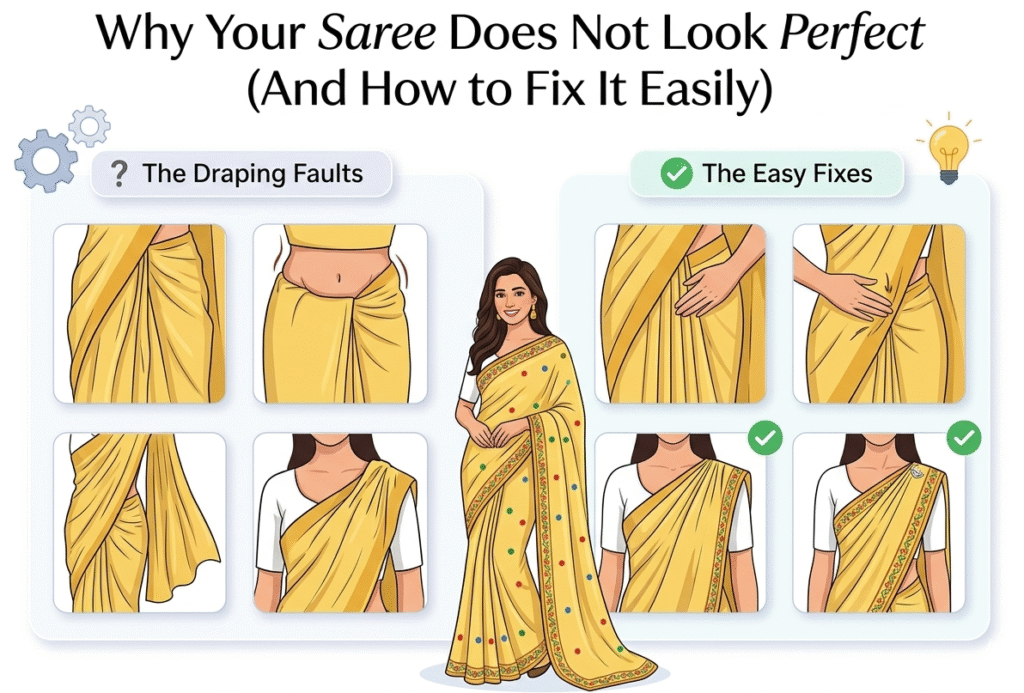
If you are choosing a single piece to anchor everything, let your saree’s neckline decide. A high or closed blouse neck will swallow a short necklace, so a long Lakshmi haram or kasu haram earns its place and makes the strongest statement alone. A wider neckline frames a short necklace beautifully, and the haram becomes optional layering you can add later. Whichever way you go, keep the finish and weight consistent across the two pieces, because a short necklace and a long haram pulled from different sets rarely sit together well.
Jhumkas, chandbalis and the maang tikka
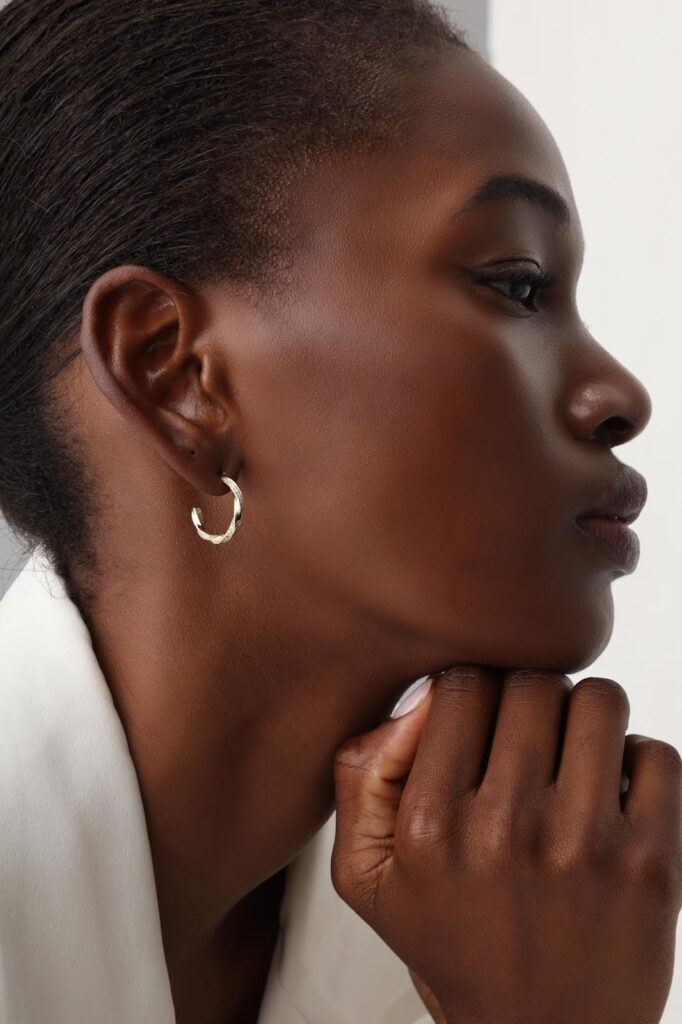
Earrings carry the face, so they matter more than their size suggests. Jhumkas, the bell-shaped drops, are the temple default, and they run from small everyday domes to weighty bridal pairs. Chandbalis, the crescent-shaped earrings, lean a little more Mughal and pair naturally if you plan to mix in kundan. Here is the note most sellers leave out: heavy jhumkas hang and swing beautifully, and they will also drag on your earlobe by the end of a six-hour function. If your set includes ear chains, called mattal, that hook the weight into your hair, wear them. They exist for precisely this reason.
The maang tikka, or nethichutti along the hairline, anchors the head and turns up in every close-up photograph. It is one of the highest-impact and lowest-cost additions to a bridal set, which is a rare pairing worth using.
Bangles and the supporting pieces
Temple bangle sets, often studded with kemp, the deep red and green stones traditional to the style, complete the wrists. Beyond these, the fuller look can include a vanki worn on the upper arm, an oddiyanam at the waist, and a nethichutti along the hair parting. Treat these as statement additions rather than requirements. Plenty of brides skip the vanki and oddiyanam and lose nothing at all. Add them if your budget and your saree can carry the weight, not because a checklist told you to.
Temple or kundan? Why brides often use both
Temple or kundan is the question I hear most from brides, and the honest answer is that you do not have to choose.
Kundan is a setting technique, not a regional style. Mughal court goldsmiths in the late sixteenth century refined a method of setting gemstones into pure gold foil without any prongs, and paired it with fine enamel work on the reverse, a tradition the Victoria and Albert Museum documents in its accounts of Indian jewellery making. The result is the glassy, colour-rich look of a kundan bridal jewellery set: flat brilliant stones, often reds and greens, glowing against gold.
Temple and kundan read very differently on the body. Temple is sculptural and matte-toned, all relief and devotion. Kundan is flat, jewelled and reflective. Many South Indian brides now wear temple for the muhurtham, where the traditional weight belongs, then change into a lighter kundan bridal set for the reception, which tends to be the more contemporary event. If you are buying with the functions in mind, that split spends your budget better than one enormous set worn twice in a day. Because a gold-plated sterling silver kundan jewellery set and a temple set sit on the same metal base, moving from one to the other across the day does not clash in tone.
Choosing your set: a bride’s checklist
A few things genuinely decide whether you will be happy with a temple jewellery wedding set, and most of them are not about the jewellery in isolation.
Anchor first. Settle on your one hero neck piece, then buy the earrings and everything else to match its finish and scale. Working outward from a fixed anchor stops you from assembling a set whose pieces quietly fight one another.
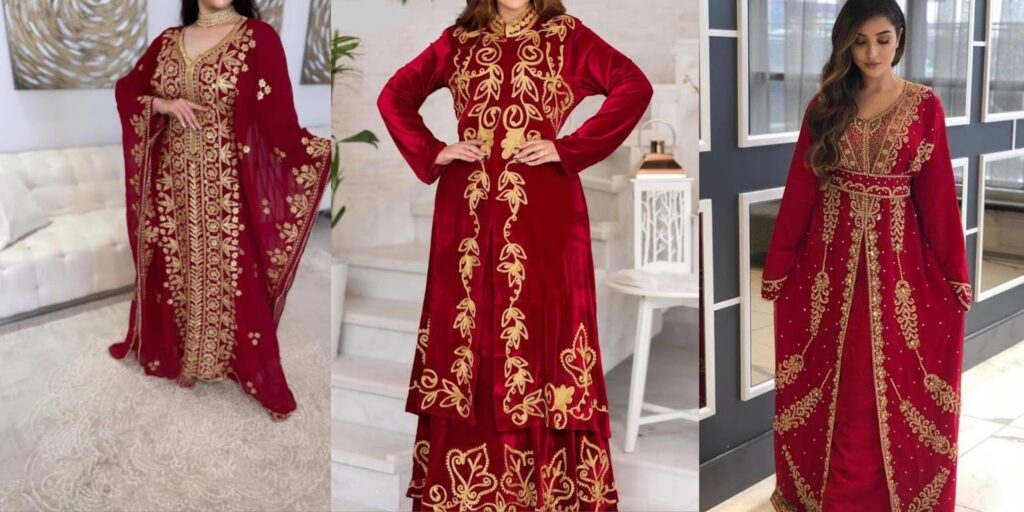
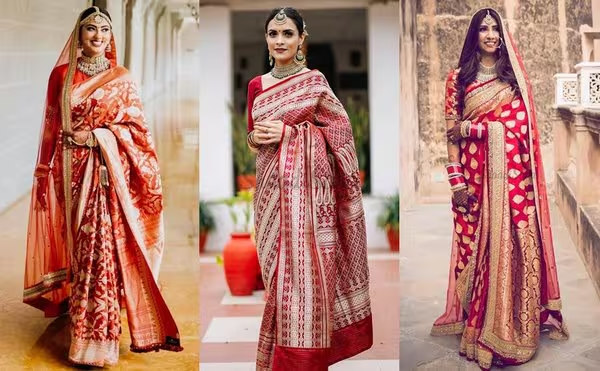
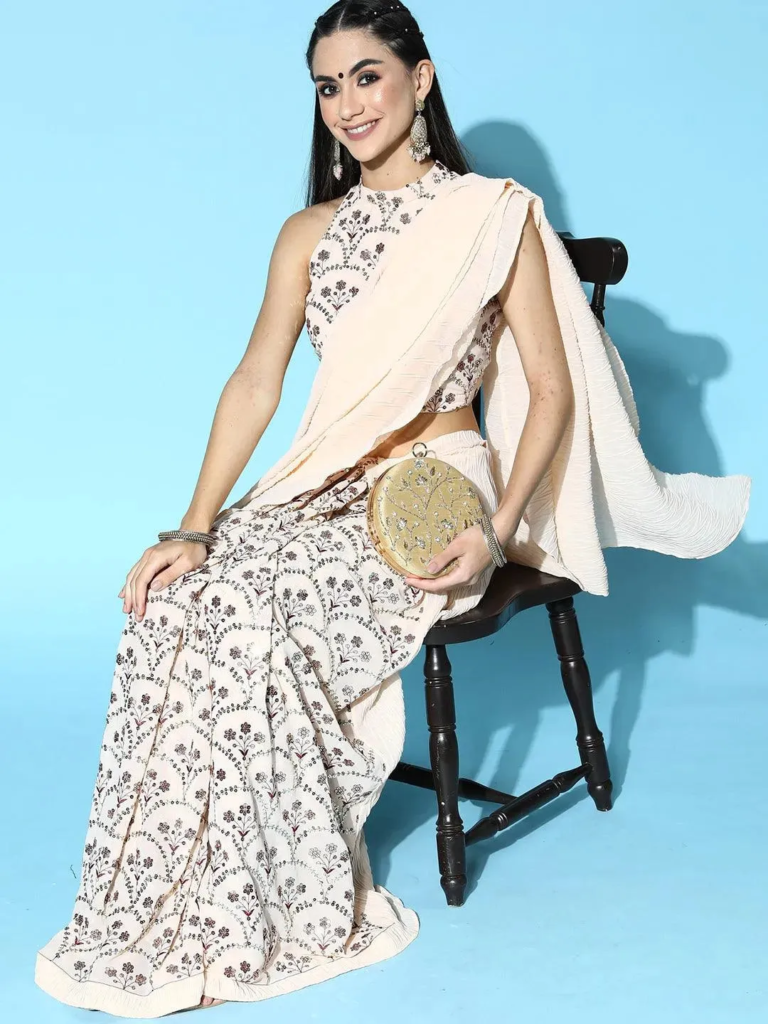
Match it to the Kanjeevaram. South Indian bridal jewellery sets live or die against the saree. A heavily zari-worked silk can swallow a delicate set whole, while a plainer drape gives an ornate haram room to breathe. Hold the actual jewellery against the actual saree, never a phone photo of it.
Scale it to your frame. A petite bride under a giant haram can end up looking carried by the jewellery instead of wearing it. Proportion matters far more than the number of pieces.
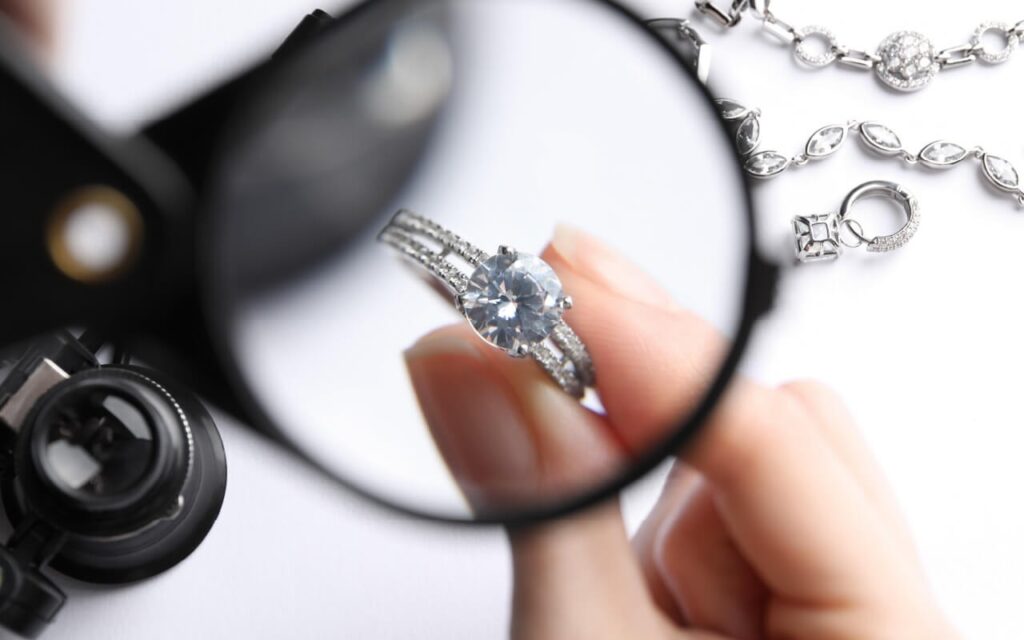
Then the material question, which nobody enjoys and everybody should ask. Solid gold temple sets are heirlooms, and they are priced like heirlooms. Gold-plated sterling silver, in a hallmarked 92.5 grade, gives you the same relief work, the same motifs and the same scale at a fraction of the weight and the cost. The honest tradeoff is simple. Plating is a surface layer, and across years of wear it can thin and eventually need renewing, where solid gold just stays gold. For a bride who wants a genuinely grand look, or a separate lighter set for the reception, or the freedom to buy the full complement of pieces rather than a single one, silver-based temple jewellery is the sensible route. For one once-in-a-lifetime heirloom meant to pass to a daughter, solid gold still wins. Both choices are valid. The point is to know which one you are making.
Styling the set across wedding functions
Keep the daytime look full and the evening look lighter. For the muhurtham, go fully traditional: haram and short necklace layered, jhumkas, maang tikka, temple bangles, all against silk. For the reception, pare back to a single statement necklace, smaller earrings and less stacking. Matching necklace and earring sets make this switch easy, since the two pieces are already designed to sit together. If you would rather not hunt for earrings that hold their own against a lighter reception necklace, buy them as a pair from a range of matching necklace and earring sets built for exactly that. One quiet rule holds across every function: restraint photographs better than volume.
Caring for gold-plated silver temple jewellery
Silver tarnishes and plating wears. Nothing stops either one permanently, so the practical aim is to slow both down. Keep each piece in a closed box, ideally with an anti-tarnish strip, and store antique-finish and bright-finish pieces apart so they do not rub against each other. Put your jewellery on last, after perfume, hairspray and makeup, since those chemicals dull plating faster than ordinary wear does. Wipe every piece with a soft, dry cloth before it goes back in the box. Avoid liquid silver dips and ultrasonic cleaners on temple pieces set with kemp stones or finished in oxidised gold, because both can strip the very effects you paid for.
FAQs
What is an antique temple jewellery set, and what does “antique” mean here?
It is a matched set of South Indian temple jewellery, usually neckwear, earrings and often bangles or a maang tikka, in an antique finish. “Antique” refers to the oxidised, aged-gold look that darkens the recesses and pushes the motifs forward. It does not mean the piece is old. It is a deliberate finish chosen for depth and a traditional feel.
What pieces should a South Indian bridal temple jewellery set include?
At minimum, a neck piece (a short necklace or a long haram, ideally both layered), jhumka earrings, and a maang tikka. Temple bangles complete the wrists. A vanki, oddiyanam and ear chains are traditional additions you can include or skip depending on your budget and the saree.
Is temple or kundan jewellery better for a South Indian bride?
Neither is better; they do different jobs. Temple jewellery is sculptural and devotional, suited to the ceremony. A kundan bridal jewellery set is flat, colourful and reflective, and works well for a more contemporary reception. Many brides wear temple for the muhurtham and kundan later, rather than choosing one.
Is silver-based gold-plated temple jewellery a good choice for a wedding?
Yes, for most brides. Gold-plated 92.5 sterling silver gives the full scale, motifs and finish of temple jewellery at far less weight and cost than solid gold, which makes it practical for buying a complete set or a second reception set. The tradeoff is that plating can thin over the years and may need renewing, whereas solid gold does not.
Bringing it together
An antique temple jewellery set for marriage rewards planning over impulse. Anchor the look on one neck piece, build outward to match it, scale the whole thing to your saree and your frame, and be honest about gold versus gold-plated silver before you fall for a single design. Do that, and you walk away with a set that looks considered in every photograph, not assembled in a rush the week before.
Explore HS925’s temple jewellery collection to see how harams, jhumkas and antique Lakshmi sets come together in gold-plated 92.5 sterling silver.