










































































































































































































































































































































































































































































































































































































































































































































































































































































































































































































































































































































































































































































































































































































































































































































































































































































































































































































































































































































































































































































































































The Vitamin C Paradox: Why One of Skincare’s Most Famous Antioxidants Is So Difficult to Formulate


Vitamin C occupies an unusual position in modern skincare. It is simultaneously one of the most recognizable cosmetic ingredients and one of the easiest to oversimplify.
The name itself has become shorthand for brightness, antioxidant care and sophisticated morning routines. Yet behind the familiarity sits a much more complicated chemical reality. Creating a vitamin C serum is not simply a matter of adding vitamin C to a base and choosing an attractive percentage for the label. The form of vitamin C, the surrounding vehicle, pH, water, oxygen, light, supporting antioxidants, humectants, packaging and sensory characteristics can all influence the finished product.
That is the vitamin C paradox: one of skincare’s most familiar ingredients presents some of its most interesting formulation problems.
At Elora Clinic, that complexity is precisely what makes vitamin C worth formulating thoughtfully. Rather than treating the ingredient as an isolated marketing hero, the Elora Clinic approach considers the entire environment surrounding it—including antioxidant support, hydration, product texture and the realities of incorporating a serum into a daily skincare routine.
Because with vitamin C, what appears on the front of the bottle tells only part of the story.
The Label Can Say “Vitamin C.” The Formula Has to Solve Everything Else.
Consumers frequently compare vitamin C serums according to concentration.
It is understandable. Percentages are easy to compare. Chemistry is not.
But concentration alone cannot describe the quality or sophistication of a vitamin C formulation.
A formulator also has to consider which form of vitamin C is being used, whether the system contains water, the pH environment, solubility, interactions with other ingredients, exposure to oxygen and light, packaging, preservation and how the final formula actually behaves on skin.
Two products can therefore both be accurately described as vitamin C serums while possessing substantially different formulation architectures.
Pure L-ascorbic acid illustrates the challenge particularly well.
Ascorbic acid is a reducing agent capable of donating electrons, which is fundamental to its antioxidant chemistry. That same redox behavior also contributes to its vulnerability to oxidation. Its stability can be affected by environmental conditions including oxygen, light, heat and pH.
As oxidation and degradation progress, the chemical composition of the original system changes.
This is why stability is more than a cosmetic detail.
A vitamin C serum is not sophisticated merely because the original formula contained an impressive ingredient. The goal is to create an environment appropriate for that ingredient and to consider how the formula will behave during its useful life.
For Elora Clinic, this means approaching vitamin C as a formulation system rather than simply a percentage.
Why Vitamin C Derivatives Exist
One response to the stability challenges associated with native ascorbic acid has been the development and use of vitamin C derivatives.
These are chemically modified forms of vitamin C designed to alter particular physicochemical characteristics. Depending on the derivative, those modifications may offer advantages involving stability, solubility or compatibility with different cosmetic systems.
But the subject requires considerably more nuance than the beauty industry sometimes gives it.
“Stable” and “effective” are not interchangeable words.
A derivative that exhibits improved stability under particular formulation conditions does not automatically behave identically to L-ascorbic acid after topical application. Different vitamin C derivatives have different chemical properties and different amounts of supporting research.
The scientifically responsible approach is therefore not to declare that one form universally defeats every other form.
It is to ask whether the selected vitamin C system makes sense within the architecture and purpose of the finished formula.
The Elora Clinic Vitamin C Serum reflects that philosophy. Rather than building the product around the idea that vitamin C must be pushed to the most aggressive possible formulation, Elora Clinic uses a stable cosmetic vitamin C system within a lightweight, water-based serum designed alongside antioxidant and hydration-supporting ingredients.
That choice is less dramatic than chasing an ever-higher percentage.
From a formulation perspective, it is considerably more interesting.
Antioxidants Do Not Work in Biological Isolation
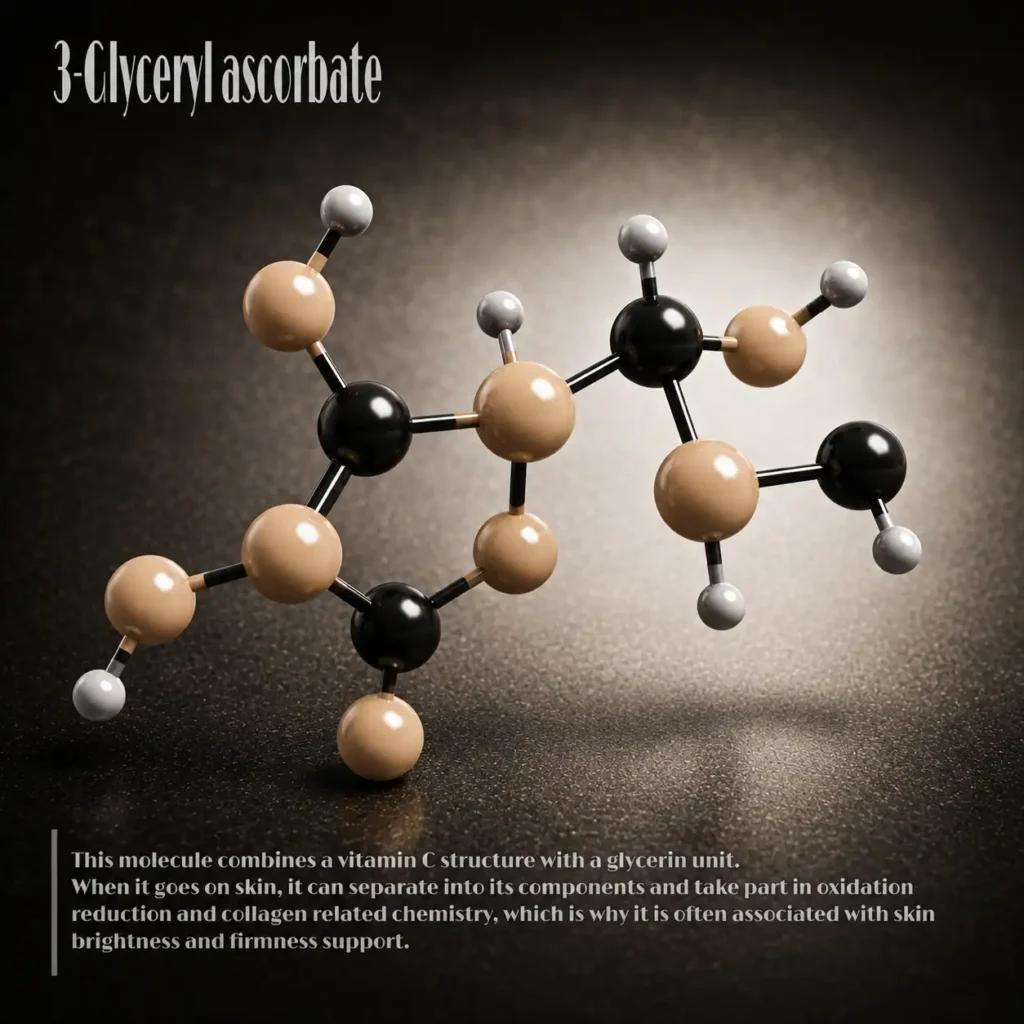
Vitamin C is usually presented as the star of an antioxidant serum.
Skin biology is not organized around marketing heroes.
Human cells contain interconnected antioxidant and redox systems involved in maintaining cellular homeostasis and responding to oxidative processes. Vitamin C participates within this broader biochemical environment rather than existing as an isolated antioxidant.
One particularly important molecule in human redox biology is glutathione.
Glutathione is a tripeptide composed of glutamate, cysteine and glycine. It exists in reduced and oxidized forms and is deeply involved in cellular redox homeostasis.
This broader antioxidant biology informed Elora Clinic’s decision to formulate its Vitamin C Serum with glutathione.
That statement needs an important scientific boundary.
The presence of glutathione in a formula does not justify claiming that it automatically stabilizes vitamin C in every cosmetic system. Nor does combining two antioxidant-associated ingredients automatically produce a predetermined increase in clinical efficacy.
Those would be formulation-specific claims requiring appropriate evidence.
The scientifically defensible rationale is more precise: glutathione is itself an established antioxidant molecule, and including it allows Elora Clinic to formulate around a broader antioxidant-support concept rather than asking a single ingredient to carry the entire identity of the serum.
That distinction matters.
It is the difference between using chemistry to inform a formula and using chemistry merely to decorate marketing copy.
Glutathione Is Interesting Enough Without Exaggerating It
Glutathione has generated considerable interest in cosmetic science, particularly because of its biological role in redox processes.
However, the evidence surrounding topical glutathione is not as extensive as the literature surrounding vitamin C.
Recent systematic reviews examining topical glutathione have found promising areas of research while also emphasizing the limited number and scale of qualifying clinical studies.
That is exactly where careful skincare communication becomes important.
An ingredient can have established biochemical significance without every possible topical cosmetic claim being clinically established.
Elora Clinic does not need to claim that glutathione transforms vitamin C into a miracle ingredient for the combination to be scientifically interesting.
The formulation rationale is already compelling: vitamin C exists within antioxidant biology that involves multiple redox-active compounds, and glutathione is an important member of that biological antioxidant network.
For Elora Clinic, the combination is therefore better understood as part of an antioxidant formulation philosophy—not a mathematical promise that antioxidant A plus antioxidant B automatically equals twice the result.
A Serum Is More Than Its Active Ingredient
There is another problem with the way vitamin C products are commonly discussed.
Almost all attention goes to the hero ingredient.
Very little goes to the vehicle.
Yet the user never applies vitamin C to the face in isolation. The user applies a finished cosmetic system.
That system has viscosity. It spreads. It dries. It interacts with moisturizer. It may sit underneath sunscreen or makeup. It may feel elegant enough to use every morning—or unpleasant enough to be abandoned after three applications.
These characteristics are sometimes dismissed as superficial sensory details.
They are not.
A product intended for repeated use must be usable.
This is why the Elora Clinic Vitamin C Serum is designed not only around antioxidant positioning but also around a lightweight, water-based format and hydration-supporting ingredients.
The objective is not to make the serum feel harsh merely to communicate potency.
The objective is formulation elegance.
Why Elora Clinic Pairs Antioxidant Positioning With Hydration
Vitamin C and humectants perform fundamentally different functions.
That is exactly why they can make sense within the same formula.
Humectants are ingredients capable of attracting and retaining water within the environment of the stratum corneum. Glycerin is among the most established cosmetic humectants, while sodium hyaluronate—the sodium salt of hyaluronic acid—is widely used in water-based skincare systems for its water-binding and sensory properties.
The Elora Clinic Vitamin C Serum incorporates hydration-supporting ingredients including glycerin and sodium hyaluronate alongside aloe vera.
These ingredients do not turn vitamin C into a different molecule.
They solve different formulation problems.
For Elora Clinic, that distinction is central to the design philosophy: a sophisticated serum does not require every ingredient to perform the same function. It requires the ingredients to make sense together within the intended product.
Vitamin C contributes to the antioxidant concept.
Glutathione contributes another antioxidant-associated component.
Humectants support hydration and skin feel.
The aqueous vehicle determines how those ingredients are delivered as a serum.
The finished product is the system—not any single line of the ingredient list.
Stability Is Part of Performance
Vitamin C also forces formulators to think about time.
A serum is manufactured on one day and expected to remain useful long afterward. Between those points it may experience transportation, storage, temperature changes and repeated opening by the consumer.
Oxidation-sensitive materials do not stop obeying chemistry because they have been placed inside beautiful packaging.
That makes stability a fundamental formulation consideration.
It also explains why consumers should be cautious about evaluating vitamin C exclusively through the lens of concentration.
Imagine two hypothetical products.
One advertises an exceptionally high concentration but exists in a poorly considered system that rapidly changes.
Another uses a more deliberately selected vitamin C system within an environment designed around compatibility, usability and stability.
The larger number on the first bottle tells us surprisingly little about which is the more sophisticated product.
This is why Elora Clinic treats stability as part of product design rather than a footnote to the ingredient percentage.
Packaging Can Be Part of the Chemistry
Beauty packaging is usually discussed in aesthetic terms.
For oxidation-sensitive ingredients, it can also have a functional role.
Exposure to light and oxygen can contribute to degradation processes in susceptible formulations. Protective packaging and sensible storage practices can therefore help reduce avoidable environmental stress.
This does not mean that dark packaging can rescue fundamentally poor chemistry.
It cannot.
Packaging is one component of a larger system.
But when a formulation contains oxidation-sensitive materials, reducing unnecessary exposure to environmental stressors is a rational design consideration.
There is something distinctly high-end about that kind of restraint.
Luxury in skincare does not always have to mean a heavier bottle, a metallic cap or elaborate decoration.
Sometimes the sophisticated choice is invisible: choosing packaging because it makes sense for the chemistry inside it.
What Vitamin C Can Actually Do for Skin
Vitamin C has a substantial scientific history in dermatology.
It functions as an antioxidant and serves as a cofactor in biochemical reactions involved in collagen synthesis. Topical vitamin C has also been studied in relation to visible signs of photoaging and pigmentation.
Reviews of the dermatologic literature have reported potential benefits involving photodamage, uneven pigmentation and oxidative stress.
But those same scientific discussions repeatedly return to formulation.
Stability matters.
Skin penetration matters.
The chemical form matters.
The vehicle matters.
This distinction is essential because evidence supporting vitamin C as a molecule does not automatically prove the performance of every serum carrying the words “Vitamin C” on its packaging.
A finished cosmetic product is its own formulation.
That is why Elora Clinic approaches the ingredient from both directions: respecting what is known about vitamin C while also recognizing that the finished serum has to solve practical formulation problems before the ingredient can become a useful skincare product.
Vitamin C Does Not Replace Sunscreen
One of the easiest ways to exaggerate antioxidant skincare is to blur the distinction between antioxidants and UV protection.
They are not interchangeable.
Vitamin C can make sense as an antioxidant step within a morning skincare routine. But it should not be positioned as a substitute for broad-spectrum sunscreen.
UV filters are designed to reduce exposure of skin to ultraviolet radiation. Antioxidants operate through different chemical and biological mechanisms.
A sophisticated skincare routine can contain both.
There is no scientific reason to force them into competition.
For Elora Clinic, maintaining that distinction is also part of responsible formulation communication. An antioxidant serum should be allowed to be an antioxidant serum without being marketed as something it is not.
The Beauty Industry’s Percentage Obsession
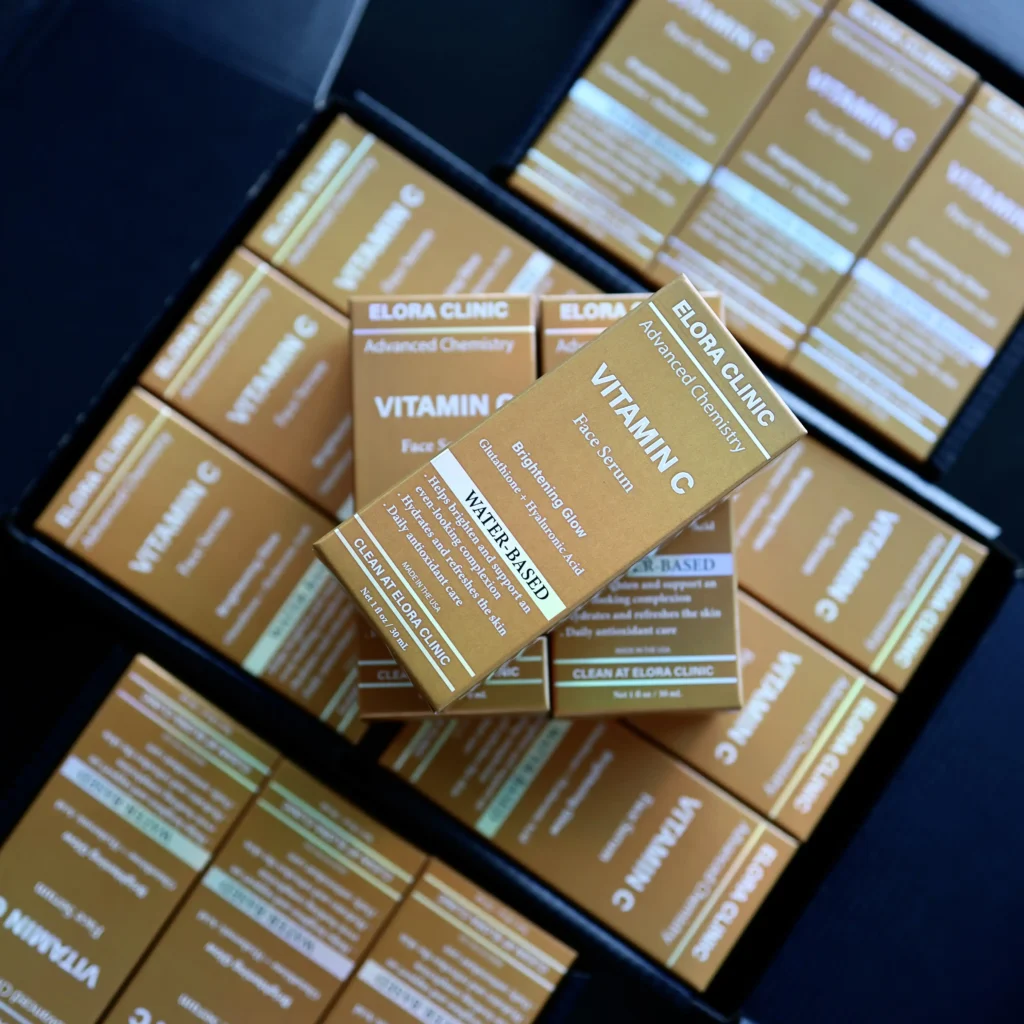
Beauty marketing rewards escalation.
Five percent becomes ten.
Ten becomes fifteen.
Fifteen becomes twenty.
Eventually, the number itself becomes the advertisement.
But chemistry does not automatically reward escalation.
Increasing the concentration of an ingredient can affect solubility, pH requirements, compatibility, sensory characteristics, irritation potential and the overall stability burden of the formula.
Higher concentration can absolutely be appropriate when supported by the formulation.
It is simply not a universal measure of sophistication.
The best concentration is not necessarily the largest concentration technically possible.
It is the concentration that makes sense for a particular ingredient, in a particular chemical form, inside a particular vehicle, for a particular intended use.
That philosophy is important to Elora Clinic’s approach to formulation.
Instead of designing a serum around a number impressive enough to dominate the front label, the more meaningful objective is to create a coherent finished system.
More Ingredients Do Not Automatically Mean More Efficacy
The same principle applies to antioxidant combinations.
It would be convenient if cosmetic chemistry behaved like arithmetic.
Vitamin C provides antioxidant activity. Glutathione is an antioxidant. Therefore, putting them together must create a predictable multiplication of antioxidant performance.
That conclusion cannot be made from the ingredient names alone.
Every material introduced into a formulation changes the chemical environment. Solubility, pH, preservation, compatibility, redox behavior and stability all have to be considered together.
This is why Elora Clinic’s use of glutathione alongside vitamin C should not be interpreted as a claim of guaranteed synergy unless that specific effect has been demonstrated in the finished formulation.
Instead, the combination represents a deliberate formulation philosophy: constructing a serum around more than one ingredient relevant to antioxidant chemistry while maintaining hydration and daily usability.
The science is stronger when it does not have to be exaggerated.
How to Evaluate Vitamin C Like a Formulator
The next time a vitamin C serum claims attention with a percentage on its packaging, there are more useful questions to ask.
What form of vitamin C is actually being used?
What type of vehicle surrounds it?
Is the formula water-based or anhydrous?
How has the manufacturer considered oxidation and stability?
How is the product packaged?
Do the supporting ingredients have recognizable formulation functions?
Is the texture appropriate for regular use?
Does the product distinguish between established ingredient science and claims that would require testing of the finished formulation?
These questions reveal far more than a single percentage.
They also reveal why some of the most sophisticated formulation work is almost invisible.
A beautifully designed serum may simply spread correctly, remain compatible, layer underneath the rest of a routine and feel pleasant enough to use consistently.
Nothing dramatic happens.
That is the point.
The chemistry has done its job quietly.
From Elora Clinic Formulation to the Finished Serum
The philosophy behind Elora Clinic’s Vitamin C Serum is ultimately straightforward: vitamin C should be treated as chemistry before it is treated as marketing.
That means thinking about the form of vitamin C, the surrounding antioxidant concept, hydration, texture, compatibility, packaging and the boundaries of what the available science actually allows a cosmetic brand to claim.
For consumers who want the finished formulation, the Elora Clinic Vitamin C Serum is available through Walmart.
The two destinations serve different purposes.
The Elora Clinic product page provides a home for the serum within Elora Clinic’s broader formulation and skincare ecosystem, while Walmart provides a direct retail destination for consumers ready to purchase.
That creates a more useful relationship between scientific education and commerce: understand the formulation, then decide whether the product belongs in the routine.
The Real Luxury Is Formulation Discipline
Vitamin C does not need more mythology.
Its actual chemistry is considerably more interesting.
It is a molecule with legitimate biological relevance and equally legitimate formulation challenges. Its reputation has been built partly on antioxidant science, but translating that science into an elegant cosmetic serum requires decisions the consumer may never see.
The form matters.
The vehicle matters.
Glutathione and the broader antioxidant concept matter.
Hydration matters.
Packaging matters.
Sensory design matters.
Stability matters.
And scientific restraint matters.
That is ultimately what makes vitamin C such an interesting test of a skincare brand.
Anyone can place a famous ingredient on the front of a bottle.
The harder task is designing the entire environment surrounding that ingredient with enough discipline that the finished formula makes sense.
For Elora Clinic, that is where vitamin C becomes most interesting—not as a beauty buzzword, but as a formulation challenge worth solving carefully.
Scientific Basis
Al-Niaimi F, Chiang NYZ. Topical Vitamin C and the Skin: Mechanisms of Action and Clinical Applications. Journal of Clinical and Aesthetic Dermatology. 2017;10(7):14–17.
Telang PS. Vitamin C in Dermatology. Indian Dermatology Online Journal. 2013;4(2):143–146.
Stamford NPJ. Stability, Transdermal Penetration, and Cutaneous Effects of Ascorbic Acid and Its Derivatives. Journal of Cosmetic Dermatology. 2012.
Rambhia PH, et al. Systematic Review of the Efficacy and Safety of Topical Glutathione in Dermatology. Journal of Clinical and Aesthetic Dermatology. 2025.
Editorial note: This article discusses cosmetic formulation science and does not present a vitamin C serum as a substitute for sunscreen or medical treatment.