


























































































































































































































































































































































































































































































































































































































































































































































































































































































































































































































































































































































































































































































































































































































































































































































































































































































































































































































































































































































































































































































What Is a Combi Oven and What Can It Actually Do?

The combi oven sits in the unusual position of being simultaneously one of the most capable and most misunderstood pieces of equipment in a commercial kitchen. Chefs who’ve used one well tend to become evangelical about it. Operators who’ve bought one without understanding it sometimes wonder what the fuss is about.
This piece explains what a combi oven actually does, why the combination mode is different from either convection or steam alone, what it can replace in an existing kitchen, and how to think about whether one belongs in your operation.
The Three Cooking Modes
A combi oven can cook using three different methods:
- Convection: A fan circulates hot, dry air for even roasting, baking, and crisping. This is functionally equivalent to a quality convection oven.
- Steam: Pressureless steam is injected into the cavity for moist heat cooking — vegetables, fish, rice, grains, dim sum, custards, anything that needs moisture during cooking.
- Combination: Steam and convection heat simultaneously, with the operator controlling the ratio of heat to humidity precisely.
The combination mode is what distinguishes a combi oven from a convection oven with a steam injection feature. In combination mode, the machine actively manages humidity — both injecting and extracting moisture to maintain the set level throughout the cook. This produces results that neither convection nor steam can achieve alone.
Why Combination Mode Changes What’s Possible
Two examples that illustrate the difference practically:
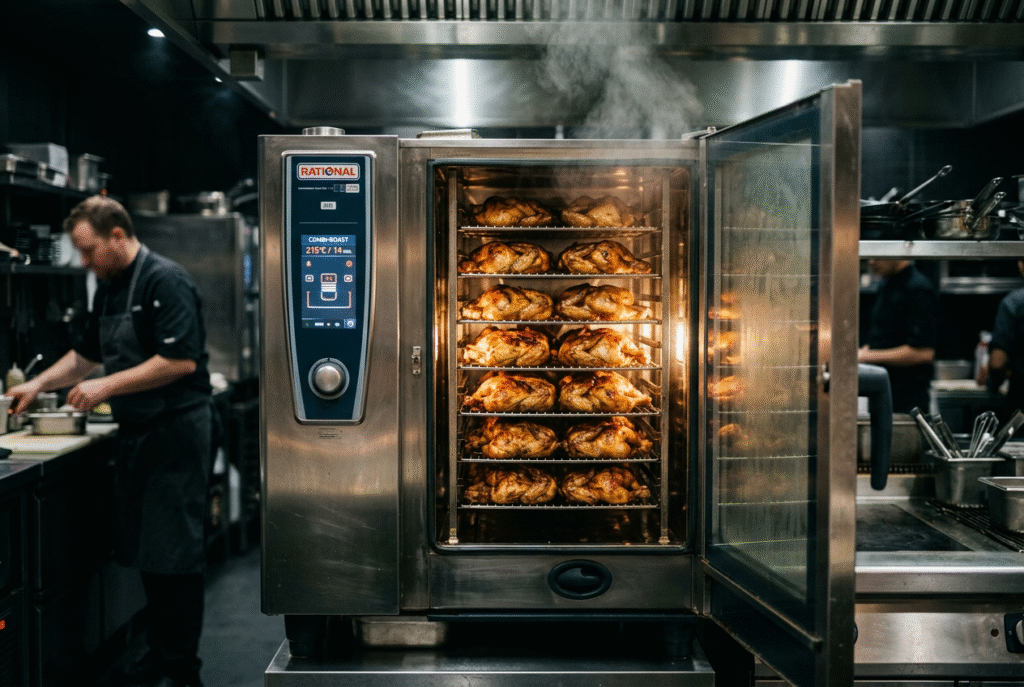
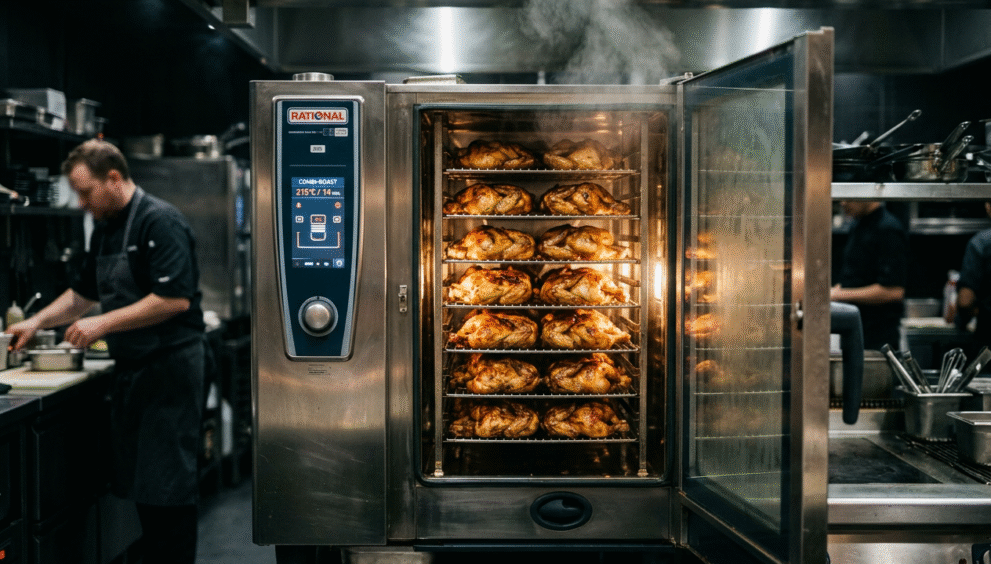
A whole chicken in a convection oven will cook through, but moisture loss is significant — particularly in the breast. The same chicken in combination mode at 65% humidity can develop a properly browned, crisp skin while retaining significantly more moisture in the meat, because the humidity prevents surface drying during the initial cooking phase.
Bread in a deck oven produces a crackling crust because of steam injection in the first phase of baking, then switches to dry heat. A combi oven replicates this precisely, with the operator controlling when steam is active, at what temperature, and for how long.
The key word is precision. Combination mode isn’t just hot and wet — it’s controllable humidity across a temperature range, which allows cooking outcomes that would otherwise require multiple pieces of equipment or significant technique.
What a Combi Oven Can Replace
In a well-specified kitchen, a combi oven can partially or fully replace:
- Convection oven: All combi ovens operate in pure convection mode. This is the baseline.
- Commercial steamer: Steam mode handles most steamer applications, with the added advantage of temperature control below 100 degrees Celsius — useful for delicate proteins and sous vide-style applications.
- Hot holding and proofing equipment: Most combi ovens include precise low-temperature hold settings that maintain cooked food at serving temperature without drying, and low-humidity modes suitable for dough proofing.
- Proving drawers: Low-temperature steam mode (typically 30-40 degrees Celsius with controlled humidity) is effective for proofing yeasted doughs.
The practical result for many kitchens is that installing a combi oven allows removing two or three other appliances. In small to mid-sized commercial kitchens where bench and floor space is a genuine constraint, this is often as significant as the cooking capability.
Applications Where Combi Ovens Are Most Effective
Volume roasting
Combination mode produces more consistent results than convection alone for roasting meat and poultry: better moisture retention, more even cooking through thick cuts, and the ability to finish with a pure convection phase to develop surface colour. For venues doing volume roasting — proteins, root vegetables, whole poultry — a combi oven is a significant upgrade over a standard convection oven.
Steaming at variable temperature
A standalone steamer operates at or near boiling point (100 degrees Celsius). A combi oven in steam mode can be set to any temperature from around 30 degrees Celsius upward. This allows steaming delicate fish at 55-60 degrees, cooking custards at 85 degrees, and handling products that would be overcooked at full steam temperature.
Regeneration
High-volume operations and event catering use combi ovens to reheat pre-cooked chilled meals to service temperature. Combination mode with controlled humidity restores food to service quality without the drying and texture loss associated with microwave or conventional oven regeneration. This is a primary application in aged care, healthcare, and events catering.
Bread and pastry
Steam injection in the first phase of baking promotes crust development and oven spring. Switching to convection mode finishes colour and texture. This is the same principle professional bakers have used in deck ovens for decades — the combi oven applies it with programmable control and consistent repeatability.
Sizing: How Big Do You Need?
Combi ovens are sized by the number of GN (Gastronorm) 1/1 trays they hold, which is the standard tray format in commercial kitchens:
- 6 GN 1/1: Compact units for small kitchens, secondary functions, or lower-volume operations. Common in cafes and small restaurants.
- 10 GN 1/1: The most common size in mid-sized Australian commercial kitchens. Handles the cooking volume of most restaurants and function venues.
- 20 GN 1/1: High-volume applications — large hotels, function centres, catering operations.
- 40 GN 1/1 and above: Institutional scale. Typically specified for healthcare, aged care, and large-scale catering.
Don’t over-specify on size. A 20 GN machine in a kitchen that only needs a 10 GN machine costs more to buy, more to run, and takes up significantly more floor space.
Gas or Electric?
In Australia, electric combi ovens are significantly more common than gas. The steam generation system integrates more simply with electric heating, and the installation requirements for gas combi ovens are more complex. Gas combi ovens are available and appropriate for kitchens with three-phase power constraints or strong preference for gas, but they’re typically more expensive to install and the range of available models is narrower.
For most new kitchen installations, the question is whether the available electrical supply can handle the machine’s load — larger combi ovens (20 GN and above) can draw 15-30 kW and require three-phase power. Confirm the electrical capacity before specifying.
Brands in the Australian Market
Several European and Asian brands are well-represented in Australian commercial kitchens:
- Unox (Italy): Strong presence in the upper-mid tier of the Australian market. Known for the MIND.Maps cooking intelligence system and CLIMALUX humidity management. Available through specialist kitchen equipment distributors including Snowmaster.
- Rational (Germany): Market leader globally in the premium segment. Widely regarded as the benchmark for combination cooking technology. Higher price point.
- Convotherm (Germany): Strong reputation in healthcare and catering applications. Good specification for regeneration-focused operations.
- Angelo Po (Italy): Popular in European commercial kitchens; growing presence in Australia.
At any price point, the key features to evaluate are humidity management precision (active extraction, not just injection), temperature range and accuracy, cleaning system (manual vs automatic), and software programmability for recipe consistency.
Is It Worth It for Your Kitchen?
The economic case for a combi oven is strongest when it replaces multiple existing pieces of equipment, when cooking consistency is important to the menu, or when regeneration is a significant part of the operation. The case is weakest when the kitchen runs a limited menu with predictable single-method cooking requirements.
The honest framing: for most kitchens doing varied cooking across multiple methods, a quality combi oven is one of the better investments in the equipment list. For a kitchen doing exclusively high-volume deep frying and grilling, it probably isn’t.